Post a message or share your memories and photos.
Professor Hirschl, it is difficult to know what to write because there are so many small memories that come to mind. I was fortunate to be your student in POL337, The Canadian Constitution, in Winter 2025. I remember coming to your office hours, the stories you shared with us about the remarkable people you had met through the University of Toronto, and the way you encouraged us to believe that one day we might become part of those worlds ourselves. I remember our last day of class, when you brought sandwiches and fruit for us, and the last time I saw you, by chance, on the stairs as I was leaving my exam. I remember you telling us to write to you even years later because you wanted to know where your students had ended up. Seeing your photograph and learning of your passing brought back not only memories of you, but of an entire period of my life. It reminded me of how much of my undergraduate years were shaped by the professors, conversations, and people I encountered at UofT, many of whom I may never cross paths with again. You were one of those people, and I am grateful that I had the chance to be your student. Thank you for reminding us that our lives could extend far beyond the classroom. I hope that wherever your students have ended up, you would be proud to know how many of us are carrying those conversations with us.
Elina Feili
The kindness and profound knowledge of Professor Hirschl, in my brief interaction with him at NYU Law has left an indelible impression. I shall forever be grateful for having the privilege of being his student.
Rohini Prasad
I think of Professor Hirschl each day. Studying under him changed the direction of my education. His example reminded me that there are good and thoughtful people in this world at a time in my own life when I felt disaffected and disillusioned with university. He showed me the best of teaching and of mentorship.
He had a capacious mind and an enthusiasm for learning that suffused his classroom. Professor Hirschl’s courses were unique spaces of study and laughter, bolstered by his keen sense of humour. Most of all, he had a profound sense of care for his students and his community which coloured each interaction one had with him.
Professor Hirschl was a luminous and humane educator. It was an honour to learn from him. He was, and will always be, an inspiration to me as a scholar and as a human, as he was for so many.
Jacob Buchan
I knew of Ran first through his work. Towards Juristocracy was assigned in a graduate seminar during the first semester of my PhD program. It kindled my enthusiasm for public law.
Soon after, I met Ran in person at a graduate student conference at UT Austin. I couldn't believe that /the/ Ran Hirschl had not only attended my panel but went out of his way to congratulate each panelist on our rigorous and worthwhile early career work.
That brief and warm encounter was pivotal for me. It helped me feel like there was a place for me in the subfield. I've since graduated and started as an assistant professor. To pay it forward, I try to extend that same warmth and encouragement to others in the field. (And I recommend Towards Juristocracy to anyone I can.)
Alice Timken
I'm heartbroken by the passing of Ran Hirschl. I got to know him through his brilliant book on cities and the constitution, and his excellent keynote on the same subject at the Massey Cities Summit in 2021. Ran was a generous, creative, straightforward, and intensely curious scholar and person. My heart goes out to his family, friends and colleagues.
Alexandra Flynn
I was briefly enrolled in Ran’s undergraduate course at the University of Toronto in the early 2010s. I will never forget how he welcomed us on the first day: He pointed to random objects in the lecture hall and named various things that we would have seen around campus on our way to class, following each item with a plainly stated “ninety-one” or “ninety-two”. He was, of course, referring the sections of the Constitution Act, 1867 that set out the federal and provincial division of powers. The point was that the constitution was not remote or merely theoretical, but rather something that was relevant to us and that affected our daily lives. My interest in constitutional law was then only just beginning to develop, and I wish I had toughed it out it given how the field has since become a significant part of my professional life and a source of personal enjoyment. My highest admiration to him and my condolences to all who knew and appreciated him.
John Gross
I met Ran three times. The first meeting was the most significant. I had been invited to the University of Melbourne in June 2019 to contribute to a workshop on cities. I spoke about the UK and about local government there. In the following tea break, Ran sought me out and came with comments and questions which showed both that he found my work genuinely interesting and that he wanted to input something of value to - what was then - a developing project. I met Ran subsequently at UT at Austin and at IE University in Madrid at conferences. He still remembered me from that initial meeting in Melbourne, which says everything about Ran. As he flew higher and higher, he never neglected or forgot those still trying to get off the ground.
A parting comment. At the Global Summit on Constitutionalism at UT, Austin in 2023, someone walked into a panel just after it had started. Momentarily distracted, I turned around to see who had come in. I saw Ran sitting down. He looked at me and winked.
Legend.
John Stanton
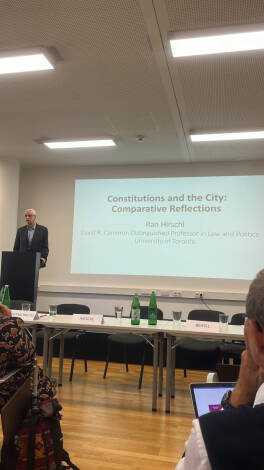
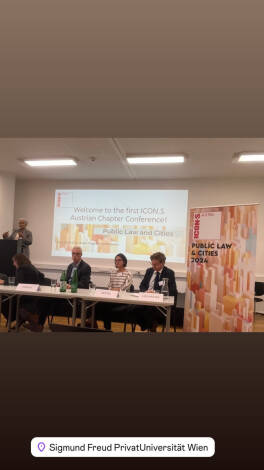
I had been following Ran Hirschl’s work and reading his publications for many years, but I finally had the opportunity to meet him in person in Vienna, where I traveled to attend the ICON•S Austria Conference in autumn 2024. During a break in the proceedings, I approached him to introduce myself. With remarkable warmth, he joked that he was delighted to meet the best-dressed participant at the conference (I suppose I was a little overdressed in a suit, tie, and pocket square).
During our brief conversation, he remarked that his scholarship on constitutional adjudication had attracted considerable attention in Turkey before 2010, but that this interest had subsequently faded. I responded that this development seemed to fit perfectly with his own thesis: following the 2010 constitutional amendments, the institutional structure of the Turkish Constitutional Court transformed—and with it, the Court's role in Turkey’s constitutional and political order. In that new context, the Court gradually ceased to be perceived as a tutelary institution. He appeared genuinely pleased by this observation.
We agreed to meet again on another occasion, but unfortunately, that opportunity never arose. I will always remember him for the warmth, humility, and kindness he showed me when we met.
May he rest in peace.
Volkan Aslan
Although I only knew Dr. Hirschl for around a year, his enthusiasm and love for teaching us undergraduate students was simply unmatched. I have never come across a prof more caring and benevolent than him. I took a Canadian Constitution course with him it was arguably the most transformative educational experience of my life. I’ll miss his passion for teaching and the wonderful dad jokes he made during class. He had a unique ability to make you feel seen rather than merely being one of the 70k students just passing through each year. When I went to his office a few months after the course had ended, he saw me and charmingly said “Ah! How are you my friend? Take a seat!” Dr. Hirschl not only made me find a passion for constitutional law, but also made me realize the type of person I wish to be in life. We will miss you a lot, Professor.
Kian Amirpoor Daylami
Ran Hirschl was everything you might want in a scholar, a teacher, a colleague and a friend. I deeply regret that I did not have more opportunities to learn from him and equally importantly to learn with him. Ran was that extraordinarily gifted scholar able to see new patterns, pathways and interpretations. He met and exceeded the scholarly attributes for which I have the highest regard, namely creativity and originality.
I have three memories to share. My first was around the time of the publication of Towards Juristocracy in 2004. Mark Graber at Maryland invited both Ran and Tom Ginsburg – whose Judicial Review in New Democracies had come out at nearly the same time – and together they really lit an intellectual spark for me – two different perspectives on a deeply important and relatively little studied area at the times, namely comparative judicial review. It was an object lesson in how the academic enterprise should be pursued – collaboratively and in serious give and take. Ran and Tom engaged the audience (mostly junior faculty) put some incredibly exciting ideas on the table, and invited discussion with the audience as much as each other.
The second moment that comes to mind was in 2007 I think … when I invited Ran to participate in a Mellon Foundation sponsored Sawyer Seminar at Berkeley. He came to Berkeley twice, once as an instructor in the seminar itself, a second time when the participants met to discuss the book project. He would once again offer fresh, provocative and compelling arguments deeply grounded in political theory for a chapter that would be titled “Constitutional Courts as Bulwarks of Secularism” in the book that emerged from that project (Consequential Courts: Judicial Roles in Global Perspective). And as always, he was a great teacher as well, and the students were captivated.
My third moment was a lucky accident. I had been invited to guest lecture at the University of Gottingen in Germany. Heading to class one morning, I stopped at what had quickly become my favorite coffee shop and did a double-take when I overheard a conversation in English about comparative courts. I looked around and was delighted to see a smiling face at a table piled with research projects Ran was discussing with his R.A. Ran immediately insisted we have dinner where I had the chance to meet Ayelet who was heading a Max Plank institute in Gottingen. It was really a wonderful dinner, the sort that makes the academic life so attractive. I am so very sorry that this was my last interaction with Ran, but it was a memorable one. A wonderful evening.
This is a most profound loss on so many levels, but I am grateful for the memories I have. Ran is a model and an example for all of us and he will be deeply missed.
Gordon Silverstein
It's heartening to see the consistency in the tributes to Ran here. He truly set an exceptionally high bar for scholarship, producing outstanding work at a prolific pace. But even more importantly, he found time to offer advice, provide comfort, and trade jokes with so many of us. When I needed help, he never wavered or hesitated. He always answered the call affirmatively, with generosity. This was true when I first met him as a postdoc and remained true over many years as a colleague. I will miss him dearly and send strength and love to Ayelet and Shai. I know Ran's memory will be a blessing to them.
Phil Triadafilopoulos
I first came to know Ran Hirschl through the pages of his books, and, in particular, in 2004, whilst reading the splendid pages of *Towards Juristocracy* and, subsequently, *Comparative Matters*. It is a moving experience to read the writings of a Master – a giant of comparative constitutional law, as well as a great methodologist and epistemologist. Thank you for your unforgettable lectures.
Roberto Scarciglia
The news about Ran’s death deeply saddened me. Why did he have to leave us at such a young age? He still had so much to give: love to his family, warmth to his friends, the highest standard to his colleagues, and wisdom to the world. I will remember forever the many conversations we had, in which he showed me the right way in my profession and life; I will never forget this and will miss him deeply.
Emanuel
Emanuel Adler
Though I joined the Department of Political Science at University of Toronto only one year ago, I was lucky enough to interact with Ran multiple times during the Fall semester of 2025. He was exceptionally supportive of junior scholars and incredibly generous with his time and advice. We talked extensively about the beauty of Florence and Tuscany, the joy of friendships and collaborations across countries, and the tireless dedication that academic writing entails. I will never forget his words of encouragement and his unrivaled ability to build a community of scholars across generations, methodologies, and disciplines. My heartfelt condolences to Ayelet, Shai, and Ran’s family at large for this devastating loss.
David Ragazzoni
I write every day, like most of the people who knew Ran. But it's difficult to find the right words to pay tribute to him.
I think the simplest way to describe Ran's impact and legacy is that he made everyone around him better. Just like you can tell when a generational talent is on the field in sports because everyone around them reacts to their movements, the scholarly communities in which Ran moved reacted to him. As others have written, his ideas sparked new ways of thinking for others, opening up new possibilities for research. His dedication to the craft of research and writing also made everyone around him feel the need to rise to his implicit (sometimes explicit) challenge.
I first really met Ran in Hannover in 2017. Along with Zach Elkins and Robert Shaffer, I had traveled there to participate in a conference. Ran sat across from me at lunch, and we had a good talk. He was of course, already a legend. It was a bit intimidating to talk to him, not only because of his reputation, but also because he seemed to see and understand people in a penetrating way.
About a year later, I had the profound privilege of being offered a postdoctoral fellowship under his supervision (and Ayelet's) at the Max Planck Institute in Göttingen. He actually shared his office (the best in the building) with my humble self. We worked together for the next three years, including via remote weekly meetings with his small team of fellows during the first year of the pandemic.
I learned so much from him about the substance of our shared work, but also about how to be a better colleague, mentor, friend, and father. He loved familial metaphors, and two of them are top of mind just now. When I would begin a meeting with an excited spiel about an arcane point that was obsessing me that day, he would say 'Explain it to me like I'm your grandmother' -- his version of Feynman's famous dictum. He was also a caring mentor, and in this case he would often say that we needed to 'do what is in the best interests of the child' (the mentee).
In the years after I had moved on to work elsewhere, he was a dependable encourager and writer of letters. It will be sad to visit Toronto again without the hope of meeting him for a coffee and a good talk.
Alexander Hudson
Ran was one of a kind. I'm profoundly grateful to have known him and to have benefited from his generous mentorship. Our paths crossed in various places since I was a graduate student at the University of Texas, and I always left our conversations with some nugget or insight that stuck with me.
I remember one conversation with Ran at ICON-S 2024 in Madrid. I mentioned that it was my first ICON-S meeting, but that I had enjoyed every session and felt more at home than I had at any other academic conference. He jokingly asked what had taken me so long to attend and exclaimed, "These are your people, Christina!"
In both his demeanor and his scholarship, Ran always made room for others at the table. I'll truly miss his presence, and remain so incredibly grateful to work in a field that he shaped so well.
Christina Bambrick
Ran Hirschl's works were a huge inspiration for my PhD. His contributions to comparative constitutional law and methodological categories were critical for my understanding of the decisions to be made for that purpose. We personally met at the ICON-S meeting in Brasilia in 2025. He chaired a panel were I presented. Naturally, I was nervous and expected very sharp comments to my modest contribution. Still, he was incisive, but kind. Critical, but constructive. Both his indepth knowledge of comparative constitutional law as well as his capacity to genuily engaged with another person's work and point of view, are examples of his great stature as an intellectual and a kind person. I will always appreciate this experience and the opportunity to meet him.
Esteban Szmulewicz
Ran is an inspiration. He is an intellectual giant, who was always so welcoming and kind to me from the first moment I arrived at U of T. His brilliant insights and gentle support will be sorely missed. My thoughts and prayers are with Ayelet and Shai at this difficult time.
Nancy Bertoldi
Many people will remember Ran as a brilliant scholar and an extraordinary teacher. He was of course both. But my principal memory of him is as a concerned, supportive colleague. After my heart attack, whenever he’d stop into my office, he wouldn’t talk of courts or constitutions but would grill me on how I was really feeling and hassle me about taking care of myself. I hope he knew how much that meant to me.
Graham White
I was deeply saddened and shocked to learn of Ran’s passing. He was a wonderful person and a significant mentor to me during the later stages of my PhD. I remember him with great fondness and gratitude.
Mitu Sengupta
Kamau and I met Ran at the Early Learning Center in the mid-2000s, often when he was coming to pick up Shai, the best buddy of my son at the time. Since then, I kept on bumping into him at university. Always present and gentle, there was something quite human, witty and warm about his presence with children, and with us parents and colleagues.
I have been keeping track of some of his scholarship, also amazed by his intellectual acumen. But I would say mostly, he was a man with the heart in the right place. In an epoch where masculinities are battlegrounds, Ran was living something exemplary - that we can be complex and kind, scholarly abstract and deeply there, and gently in touch with little ones.
Fly high and free, wherever you are, Ran.
valentina napolitano
Ran was a true superstar. But he was equally a super-sweet guy, a real Mensch, with a wonderful sense of humor. Honestly, he was one of my very favourite colleagues. Ran & I shared 2 book launches -- one in 2011 & one in 2014. We joked that we each had to keep writing books every three years so we could keep that tradition going. But the flow of books from Ran's pen, & from his formidable intellect, made it pretty hard to keep up with his pace. When he & Ayelet were in Berkeley, they went out of their way to take our son Gabriel (a Berkeley grad student) out to lunch. (See photo.)Typical of his generosity and friendship. A devastating loss -- for scholarship, for his devoted friends, & of course for Ayelet & Shai.
Ronnie Beiner
With his very high standard, Ran was a colleague who inspired me. He was also someone who genuinely cheered you on. It is a rare combination. I am very saddened by his passing. The department is a lesser place in his absence. My heart goes out to Ayelet and their son.
Lynette Ong
I met Ran when he came to work at UT Austin, and he quickly became an irreplaceable part of my doctoral journey. While he served on my dissertation committee, he was so much more than a traditional member, he was my fiercest advocate, always stepping up to make my ideas shine in front of the others. I will always appreciate his enthusiasm for championing knowledge from the periphery of the world.
But above all, Ran saw me as a human being. Navigating pregnancy and the early stages of motherhood can be incredibly isolating in a male-dominated field, but Ran's kindness made all the difference.
He was a brilliant scholar, a protective mentor, and an incredible person. Rest in peace, Ran.
Paz Avila
Many years have passed since I had the great fortune to work with Ran. I was young, in the earliest years of my career and I'd been tasked to assist him with a major on-campus event. While the work itself was routine, the process of completing it with Ran was transformative. We got along immediately, worked together with ease and enthusiasm, and when the work was done I think we both felt a sense of disappointment that our paths would not cross as frequently. He saw the best in me, mentored me with kindness and generosity, encouraged me to work as hard as I could and achieve everything I wanted. He quietly cheered me on as I pursued my graduate degree, got married and started a family. We shared many laughs and drank many Diet Cokes. We chatted fondly about our families and the incomparable love he felt for Ayelet and Shai. My life was made better because of his presence in it.
I cannot put into words the kind of sadness I feel. It is too profound.
Meera Rai Govindaraj
The news of Ran’s passing was a shock. I carry a small but beautiful memory of him. It was during the ICON-S conference at the Universidade de Brasília, what none of us knew would be his last. The day before, I had delivered the welcoming speech at the opening ceremony. The next morning, walking through the Minhocão, the iconic central building of UnB, Ran stopped me, just to say: “great speech; short, emotional, and it sent the message of democratic resilience that is so needed these days.” He just stopped me and said it straight. I was so happy and moved to hear this from such a remarkable scholar, one who has inspired so many of us. But what struck me most was his generous gesture. This, I think, is the finest value academia can offer: generosity. And this is forever!
Rest in peace, Ran.
Juliano Zaiden Benvindo
I have been stunned and saddened by this news.
Ran's influence on comparative constitutional studies was unmatched. I will miss his towering ability to test ideas, push beyond intellectual boundaries, and think and talk through some of the biggest political and legal challenges we face. I was not surprised when I saw the topic of his next book - typical Ran. He expected a lot from the field he helped create, and thereby created excellence in a whole generation of younger scholars.
And I know he was very proud of Shai. My very best to Ayelet and to all the family.
Katharine Young
Ran was one of the academics I most admired and most want to be like. One of the things that stood out about Ran is that he always had the right academic values. He was equally like to criticize weak research by famous scholars as he was to praise strong research by junior scholars. He took what we do seriously in the very best way, and his encouragement and feedback always made me want to be a better scholar. Ran left the field of comparative law so much better than he found it. All of us that work in this area are in his debt. I'll miss you Ran.
Adam Chilton
Sadly, I never had the opportunity to meet Professor Hirschl in person, but his scholarship profoundly shaped the way I think about comparative constitutional law—or, perhaps more appropriately, comparative constitutional studies, to borrow the title of one of his most influential works. The influence that a great scholar can have on people they never meet is one of academia’s most remarkable gifts. Professor Hirschl’s work will continue to inspire scholars around the world for generations to come. May he rest in peace.
Vicente Benitez-R.
To an inspirational force...
I had the pleasure of meeting Professor Hirschl during a research visit to the University of Toronto in the spring of 2026. During that time, I was fortunate to enroll in his course on Comparative Constitutionalism and to learn from one of the great minds who contributed so much to the fields of judicial and comparative politics.
When we read the work of fellow academics, we often gain a glimpse into their intellect and character, but it is through personal interaction that we come to appreciate who they truly are. Professor Hirschl was not only a remarkable scholar, but also a deeply devoted teacher who cared sincerely for his students. Seeing that level of commitment in such an acclaimed scholar inspired me profoundly: to write more, to write better, and never to lose sight of the importance of teaching.
I wish to express my deepest condolences to the UofT community for the loss of an intellectual pillar, a colleague, and a friend to many, but especially to his partner and wife, Ayelet Shachar, and their son, Shai.
Mauricio Mandujano Manriquez
Some overdue recollections: I met Ran in 1999, the year we both joined the University of Toronto (though in different divisions). At that time, we shared a research agenda: thinking about the ‘new constitutionalism’. For Ran, constitutional renovation, with the aim of preserving elite hegemony, was his principal preoccupation, resulting in 'Towards Juristocracy.' For me, it was the construction of an international legal order serving similar purposes. We were doing law, constitutionalism, and political economy long before it was trendy. However saddened I was to see Ran drift away from our shared research interest, it was gratifying to see Ran pursue, in a series of monumental contributions, his ‘constitutional studies.’ I even had the privilege of observing up close, and learning from, his dedication to doctoral students. As others have noted, he was a model of scholarly rigour and kindness. All of this done with an ever present sly, satirical streak. Though our interactions were too intermittent, I will always cherish a friendship that ended too soon. My thoughts are with Ayelet and Shai.
David Schneiderman
I have offered some extensive memories of Ran on the conlawprof listserv. I agree with all the encomia offered to a great scholar and great person.
I will repeat one of my own memories. I took a copy of Comparative Matters with me on a trip to Jerusalem. Because of jet lag, I was having trouble remaining asleep around 3am or so, and I decided that reading one of its chapters would be just the thing to restore me to my slumbers. Instead, I got hooked and remained happily awake learning all sorts of things about the challenges of doing serious comparative analysis! That, of course, was true of everything he wrote. I have recently offered a blurb for his forthcoming book on Constititionalism in 2050, describing it, I think altogether accurately, as the most important book on constitutional theory published in this century.
But it’s also essential to remembering him that he was a truly fine human being in every respect. His memory WILL be a blessing, reminding us that great scholarship can be conjoined with true menschlikeit.
Sandy Levinson
Colleagues should die in approximate age order, so it is a cruel fate for death to claim Ran at 63. It should not have been his time or turn. We can celebrate how much he already contributed, even while grieving for all he would have gone on to do. As someone focused narrowly on U.S. constitutional law, I had my horizons broadened by reconsidering familiar topics through the sharp lens of Ran's comparative constitutional studies.
Jeffrey Abramson
Ran has been a source of inspiration for as long as I can remember. I recall being an LLM student at Harvard Law School in 2007, and having no clue on how to do research. In my dorm room, I devoured every page of Towards Juristocracy, and it inspired my very first paper. It was the first time, but would not be the last. Religion, case selection, cities, comparative constitutional studies--- each of these topics require consultation of Ran’s writing and engagement with his ideas.
We are in the business of ideas—and Ran’s ideas have mattered profoundly. They are the foundation of some of the most important insights the field has generated. They will continue to matter in the decades ahead.
Ran has also been a mentor of the best kind: generous with his time, but tough on the substance. It is the kind of mentorship we should all aspire to.
The business of comparative constitutional law involves many conference rooms all over the world. Ran and I would frequently find ourselves on the same flights and headed to the same conference rooms (with and without windows and/or air conditioning). These conference rooms will feel empty without Ran’s presence—and yet, his ideas will continue to fill them nonetheless.
The field of comparative constitutional law lost a giant, and we all lost a friend. RIP Ran.
Mila Versteeg
Professor Hirschl was easily one of the sharpest minds I had the privilege of learning from in my years at the University of Toronto. In our 10-week seminar, he pushed us to contribute and inspired many of us to engage with the world that he defined, the vibrant and cosmopolitan world of comparative constitutionalism. However, if he was just an intellectual trailblazer, he wouldn't enjoy the personal legacy he doubtlessly will. I will remember the Professor as a kind and thoughtful man, one who encouraged the next generation of scholars, and someone that gave back to the community. I aspire to his diligence and magnanimity and I feel immensely fortunate to have been his student.
Liam Wood
My tardy remembrance results from the combination of shock at the news of Ran’s passing and my general difficulty in dealing with death. I’m pretty sure that I first met Ran and Ayelet at the Graber schmooze that’s been mentioned twice—with a dinner at a restaurant the quality of which was, in Ran’s view, questionable. My primary thought is that his references to my work were, given his own contributions, overly generous. And the field will miss the contributions he could have made in carrying out the research agenda of rethinking the very content of the field that he had begun with his work on global cities.
Mark Tushnet
I really thought I would have Ran as a colleague forever. We found ourselves in the same room and conversation too few times. I have always admired his work, and I have always been happy and excited to know that Ran would be at an event, because I knew I would hear an interesting perspective.
I didn't know Ran well, but from this awful news comes the reminder not to waste an opportunity. Friends and colleagues, I'm going to find ways to grab a drink, ask you questions, and take advantage of your presence and the times we have. What a towering loss. RIP Ran
Karen Alter
I was first introduced to Prof Hirschl's work "Towards Juristocracy" in an undergraduate constitutional law class on the judiciary. Upon being admitted to UofT's LLM program, many NUS faculty members recommended that I speak to Prof Hirschl. I cold emailed him last year to ask if he could supervise my work. He very politely declined but not without leaving me with several fresh ideas on comparative constitutional law and theory, and its applications. Though brief, I treasure this very meaningful interaction with Prof Hirschl.
Andre Chua
I first met Prof. Hirschl when he very graciously attended my practice job talk at the department. I was surprised and somewhat puzzled to see him because our research interests don't overlap. He later wrote to share his comments and mentioned his interest in the constitutional design possibilities to address spatial divides. I was and still am very encouraged by his email. Thank you and rest in peace, Prof. Hirschl.
Jiajia Zhou
Fifteen years before I was fortunate enough to become Ran's colleague, I was an undergraduate student leafing through "Towards Juristocracy" (not for class, but on my own free time) and realizing that I had found my calling. Ran and the pull of his ideas are the reason why I became fascinated by the intersection of comparative law and politics, why almost two decades later I continue to study how courts shape politics and how politics structures law.
Ran was also a huge part why getting a faculty job offer from the University of Toronto truly felt like realizing a dream. The author of the book that inspired me to become an academic was now my colleague. I was, in many ways, intimidated: Ran was tall, his ideas dominating, and he was clearly a man confident about the arguments he was pursuing. Yet I quickly discovered that Ran was not only an intellectual giant who penned one pathbreaking book after another; he was also bitingly funny and extraordinarily supportive of junior colleagues and students. I witnessed how the pugnacious intellectual who took no prisoners in print was also amongst the warmest and kindest people anyone could meet. When another new hire and I organized what felt like a risky collective action effort for pay equity, Ran was immediately supportive and offered invaluable strategic advice (that worked; Ran knew how to navigate university politics to push for change like no other). When a group of us junior faculty discussed building a law and politics working group at Toronto, Ran made it happen and offered up his own funds. When undergraduate students started streaming into my law and politics classes, they recounted how they took a course with an extraordinary professor named Ran Hirschl, who made them instantly passionate about the topic.
Ran had so much intellectual firepower left, so many initiatives ready to spearhead, so many students and faculty to mentor still. I struggle to bring myself to accept that he is gone, but I count myself fortunate to have worked for three years alongside him. His ideas will live on and continue to inspire and provoke countless people who never got a chance to meet him, but those of us who were blessed to know the man behind the ideas will miss him terribly.
Tommaso Pavone
I received the news with a great sadness…his work inspired me and I am grateful for that. He was a distinguished scholar and very nice person.
Violeta Besirevic
I first met Ran when he was a visiting professor at Harvard Law School and I was a clueless LLM student. He encouraged me to pursue the scholarly path. He was a generous and welcoming mentor and teacher. And I learned so much from his work on comparative constitutional law and religion. One random story - when I experienced my first snowfall around Thanksgiving at HLS, Ran was very excited for me and the students from SE Asia.
I was very happy to join the University of Toronto and become colleagues with him. And like before, he was generous with his advice regarding faculty affairs as well as comments on works-in-progress. He liked asking, "when is the next book coming out?"
Anna Su
As I am contemplating methodology of comparative law quite often lately, I keep going back to Ran's work. Sadly, I was going to contact him to write a preface for a manuscript I am co-developing but also to ask him for advice. Met him several times, appreciate his work incredibly, and will miss him around ICON S.
Maja Sahadzic
When I took Ran's class on comparative constitutionalism (which happened to be the last class I took for my PhD) he seemed so energetic, passionate, and full of life. He was a titan in the law and politics field. I still remember talking to people in Austin at the Global Summit on Constitutionalism about my research and their eyes would always light up when I mentioned Ran was on my committee. He was so supportive and generous with me. He helped fund my conference travel to Austin. He also provided a full lunch on the last day of the class I took with him. It is so sad he is no longer with us. I will always see it as an immense honour and privilege to have known Ran and to have taken one of his last classes.
Charlie Buck
I first met Ran in person at that now storied Graber schmooze back in the nineties. The deepening friendship that began from that occasion is filled with memories that I will cherish moving forward. My last exchange with Ran was in an email about six weeks ago that I now read with sadness but which I will turn to whenever I need a reminder about character. In it he mentioned his "shaky" condition, while hastening to add that "the fight continues." That brief health update only came after some sweet sentiments about my family and its recent celebration of my eightieth. And it preceded his last comments about the "escapist solace" that his beloved Toronto Blue Jays were providing as the baseball season was beginning. I will remain loyal to my Yankees; Ran would not have it any other way. But whenever those Jays steal one from the team in the Bronx I will not sulk. I will smile and then wipe a tear from my eye.
Gary J. Jacobsohn
Deeply saddened by Ran Hirchl’s passing.
His writings were fundamental in my PhD studies, and meeting him at I.CON-S was deeply impactful. The loss feels immediate, as his character matched the quality of his work. Sharing meals at each annual meeting was a privilege I will deeply miss. My heartfelt condolences go out to his family and friends.
Micaela Alterio
A very good scholar and person. I have the opportunity to meet him in the Global Summit in Austin and in the Icons meeting in Brasília. The Universidad Externado de Colombia had translated his book “Comparative Matters: The Renaissance of Comparative Constitutional Law” (Asuntos comparativos: El renacimiento del derecho Constitucional comparado). The reading of his work will be the way that we remember Prof. Ran. A condolence for his family and friends.
Gonzalo Ramírez - Prof Universidad Externado
Deeply saddened by this news. I got introduced to his readings in one of my elective courses, taught by prof. Aparna Chandra. Prof. hirschl came out as an outlier in this discourse which not only helped me with a new perspective to think about law and politics (referring to his article on juristocracy) but also his paper on comparative methods. For every student of comparative constitutional law, these papers are very deeply researched, well written and reaches the standard that everyone must aspire to reach.
Smruti Ranjan
Your book has been a great source of inspiration for me. I am developing some of my ideas on constitutionalism based on your work. Thank you for everything, and I wish you a safe journey to your next destination, Professor.
Natdanai NAchan
Some encounters profoundly shape your path. For me, meeting Ran was one of them.
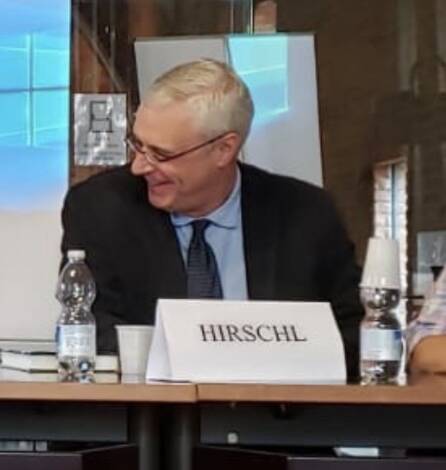
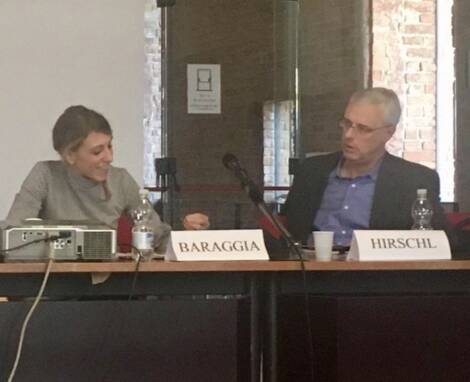
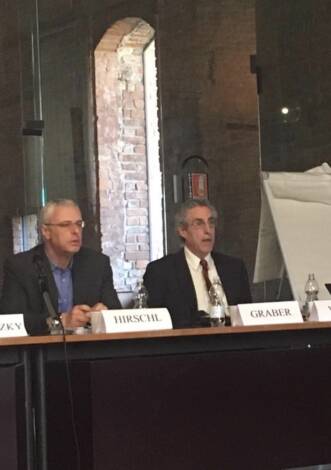
I first met Ran when, as a young post-doctoral researcher, I invited him to Milan to give a lecture on comparative constitutional method. I still remember how generous and open he was with his time, his ideas, and the attention he gave to a young Italian scholar trying to find her way in academia.
A few years later, Ran and Ayelet welcomed me in Göttingen for a short visiting stay. I have such beautiful memories of those days: every conversation with him was illuminating, opening new perspectives, and filled with warmth, irony, curiosity, and humanity.
I am sharing here some photos from the Milan Schmooze — a special moment with many friends, and one of the many memories of Ran that will stay with me forever.
My thoughts are with Ayelet and all those who loved him.
Thank you for everything, Ran.
Antonia Baraggia
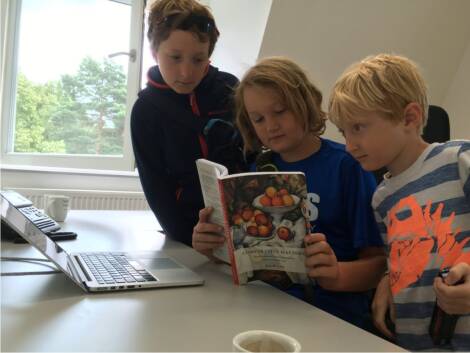
I will miss Ran terribly. He made every panel, project, or class just that much more tolerable. I loved his impatience with pretension, his wit, and his spot-on observations. He would nicely cut through the morass in any conversation with exactly the right remark, putting us all back on track and leaving us smiling. He and I edited over 60 books together (with Tom G) and we taught a course together with Richard A. at Texas -- those will always be career highlights for me. And while he was remarkable and delightful in person, his writing, wow --filled with ideas, expertly and clearly articulated. One of my favorite photos is the attached from 2015. You'll see my three kids sitting in my office in Gottingen, Germany (where Ran's amazing wife Ayelet had nicely provided me a workspace one summer). In it, the three of them are devouring Ran's then recently released book, Comparative Matters. Who knew that even kids were fans? Rest in peace, my friend.
Zach Elkins
It was with great sadness that I learned of the passing of Ran Hirschl, whose scholarship has illuminated these decades for me and for generations of PhD students at the University of Siena who have been trained on his writings. His work has always been pioneering, offering rich insights for intense and stimulating discussions, and providing a methodological framework that has guided our research.
On behalf of DIPEC (Interdepartmental Centre for Research on Comparative and European Public Law), I extend my deepest condolences to his family and loved ones. For my part, I am left with the regret of not having had the opportunity to meet him in person.
Tania Groppi
As an early- career scholar seeking a footing in the world of comparative constitutional law, I was first introduced to Ran Hirscl's work "Comparative Matters". Almost a decade in academia later, that, and his other works remain etched in my mind, and have profoundly come to shape the way I think about the discipline.
I sadly never had the opportunity to meet him in person-- I tried to meet him on a few visits to Austin, and more recently in Toronto as well. And yet, every time I cold emailed him, he responded with remarkable promptness and generosity, even offering to set up a time to discuss my ideas and work. For an junior scholar, I had scarcely expected that from an absolute giant of the field, and yet, as the numerous testimonials here show, it was very much a part of Professor Hirschl's warmth and character.
As recently as last month, I was in Toronto just for a day for a workshop. I cold emailed Professor Hirschl again, and despite having no idea he was fighting cancer, he still took the trouble to respond, expressed his regret at being unable to meet, and wished me well on my travels. The fact that I never had a chance to meet or interact with him in person will remain one of the regrets I will carry with me, and yet his ideas, warmth and generosity remain an inspiration for us all.
Neil Modi
I first got to know Ran when he wrote an essay on "constitutional theocracy" for a book that Steve Macedo and I edited. Like everything Ran wrote, this piece was stunningly original for constitutional theory and attuned to new phenomena on the ground. In the brief time he was our colleague at UT, Austin he catapulted the reputation of our program in the nation, and in the world. I am so stunned and saddened by this loss.
Jeffrey K. Tulis
Ran, it was great to work with you. Rest well
Mark Rush
Professor Ran Hirschl was a giant scholar whose work profoundly shaped the field of constitutional law, but even more than that, he was a rare mensch and an exceptionally kind, generous human being. I only wish more great scholars carried their brilliance with the same humility and openness that he did. He was never arrogant or unapproachable. He was remarkably generous with his time and ideas, and he never spared thoughtful comments and criticism — even when the criticism was sharp and substantive — but he always knew how to deliver it with kindness, encouragement, and genuine support. That combination of intellectual greatness and humanity is exceedingly rare.
Rest in peace, Professor Hirschl.
Meital Pinto
I met Ran and Ayelet when he was a PhD student and Ayelet was a law student at Yale in the 1990s, and I was immediately impressed by them both. Ran initially defined himself as a political theorist and began a PhD thesis with Ian Shapiro. But it evolved into a critique of how contemporary courts, so celebrated by many scholars as vehicles for enlightened progress, were in fact advancing the economic and social agendas of elites in much of the world. As the department's law and courts scholar, I joined in the advising, helping Ran to place his work more fully in jurisprudential and historical institutionalist frames. But I learned much more from his thesis than he did from me, and that pattern held emphatically in ensuing years, as he went on to write a series of brilliant books and articles. By then we had long since become not professor/student but colleagues and friends, but as we professors do, I still saw him as one of my academic family. And I feel his loss like that of a cherished family member. But I remember that Aristotle said you could only judge if a man was happy at the end of his life, when you could see it in its fullness. In its fullness, Ran Hirschl's life was a great and happy one, and I am grateful for that.
Rogers M. Smith
I'm still in shock. I have lost one of my very closest friends in the academy. For over 20 years, we shared ideas and conversation, meeting regularly to discuss the explosion of energy in the field of comparative constitutional law. I'll never forget one of our early conversations about our first books, nor our last dinner with Ayelet in Spain. My heart goes out to Ayelet and Shai; for the field, we have lost a giant.
Tom Ginsburg
I was deeply saddened to learn of the passing of Ran Hirschl. I first met Ran in 2019 at a conference in Milan, but I had already encountered his scholarship long before that meeting. His book Towards Juristocracy and his writings on comparative constitutional studies — especially his reflections on case selection in comparative constitutional law — profoundly shaped the way I think about constitutional scholarship. They continue to be texts that I use in my courses and recommend to my supervisees. I also personally benefited from Ran’s extraordinary generosity when he welcomed one of my books into the co-edited Constitutional Law and Policy series. Every time I sent him one of my writings, he responded with encouraging words, intellectual openness, and genuine kindness. Beyond his immense scholarly legacy, I will remember Ran for his generosity toward younger scholars and for the rare combination of intellectual rigour and human warmth that he brought to academic life. He will be greatly missed.
Giuseppe Martinico
Like many other colleagues around the world, I first came to know Professor Ran Hirschl through his fascinating books, whose intellectual force and originality shaped the way so many of us came to think about comparative constitutionalism. Years later, I had the privilege of meeting him in Austin, in the inspiring atmosphere of the Global Summit on Constitutionalism, and then again at conferences around the world. Everywhere, he remained the same: a refined and brilliant intellectual, yet also an extraordinarily warm and generous human being, always making time for meaningful and genuinely friendly conversations with those around him. His passing is a profound loss for the global academic community and for all those who had the privilege of knowing him personally. Yet his presence will remain with us through the memory of his kindness, the strength of his ideas, and the remarkable body of work he leaves behind.
MARIETA SAFTA



 Français
 Deutsch
 Nederlands
 Español
 Português
 Magyar
 Русский
 繁體中文
繁體中文