
Obituary
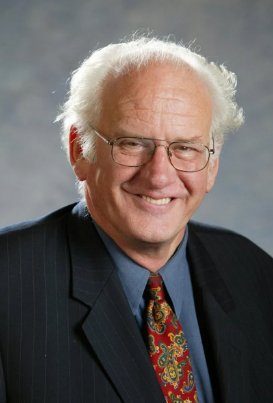
Ken Dobell was a man of great stature, not only in his physical being, but in his intellectual brilliance and his boundless generosity. His commitment to public service and in his devotion to his family were immense. Whenever you were with him, you were aware of the magnitude of his character. While some might have been initially intimidated by his forceful personality, they quickly discovered him to be an exceptionally kind, thoughtful, deeply humane and approachable person.
Born in Vancouver on November 11th, 1940, he grew up in Kerrisdale, attending Kerrisdale, Point Grey Junior High School and Magee High School and, despite his tendency towards day-dreaming, he distinguished himself throughout his schooling, being named “Topper” in Grade Six, earning academic and service awards each of the following years and becoming President of the Student Council in Grade Twelve.
Ken’s generosity was evident from a young age when he frequently opened his penny bank to children he thought, often mistakenly, were less fortunate than he. This spirit of giving continued throughout his life. Always ready to assist a friend, offering support to many during difficult times, he consistently gave more than he ever asked for.
After graduating from UBC, where he was a notable football player and was a member of both the Sigma Chi and the Sigma Tau Chi (the men’s honorary) fraternities, Ken pursued graduate studies at Birmingham University. During his time in England, he married Pamela Jackson and welcomed his first child. On his return to Canada, Ken began his career at the City of Vancouver, eventually becoming City Manager and the first ever Chief Executive Officer at the Greater Vancouver Transit Authority (now Translink).
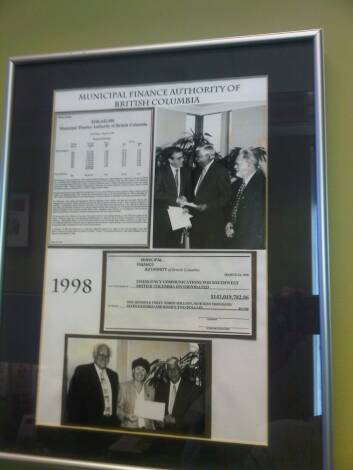
He was a key player in helping establish the E-Comm emergency communications system serving BC. Per his friend and colleague, Dave Mitchell, “He will always be known for so many things including E-Comm, which is a technical and operational success uniting the three emergency services with a shared radio network and supporting technologies. Quite simply, emergency services work better and more effectively because of his initiative.”
And Judy Rogers, who succeeded him as City Manager, said “Ken was instrumental in creating the regional emergency centre E-Comm, following the Stanley Cup riots, building of the Vancouver Public Library, Yaletown, False Creek. Ken was highly regarded in the region for his visionary leadership; he was an icon among the city managers in the region.”
Later, as Deputy Minister to the Premier he managed 30,000 provincial employees working on infrastructure projects such as the Canada Line, Pacific Gateway Project, the Vancouver Convention Center, the 2010 Olympics and Paralympics. He took a large part in resolving conflicts over the Great Bear Rainforest and the softwood lumber industry.
After leaving the public service, Ken advised several organizations such as the BC Lumber Trade Council, Port Metro and the BC Institute of Technology and helped to create the Street to Home Foundation.
While admiring many colleagues and community leaders, Ken made little of his own achievements. Nonetheless, his work was recognized by many in both the public and private sectors. In 1995, he received the Lieutenant Governor’s Award for Excellence in Public Administration. In 2002, he was awarded the Queen Elizabeth II Golden Jubilee medal, and in 2011 he was appointed to the Order of BC in recognition of his public service.
In October 2008, a gathering of municipal, federal and provincial leaders from all parties was held to celebrate his leadership. At that event, a scholarship was founded in recognition of his contributions: the Ken Dobell Public Service Education Fund Scholarship. The scholarship was, at Ken’s direction, established to encourage students with an interest in studies that would enhance reconciliation amongst local government and Indigenous Peoples to pursue post-secondary opportunities.
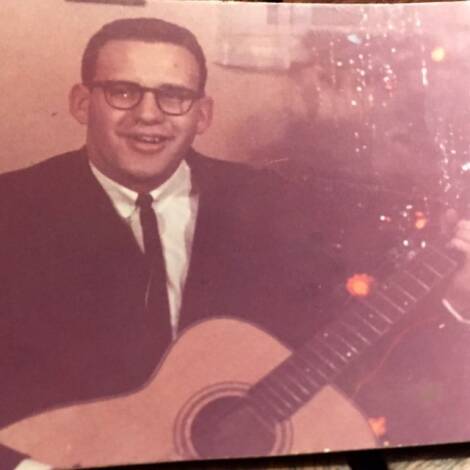
Ken was a talented musician and loved to sing, performing in high school operettas and often winning high marks in music festivals. A good guitarist, he sang the songs of Pete Seeger and Joan Baez, accompanying himself on a 12-string guitar. Concerts at the Chan Centre and the Early Music Society gave him great pleasure. One of his favourite Christmas activities was to buy tickets each year for his large extended family and some special friends to join him at the Orpheum Theatre for a performance of the Messiah.
He revered the music of Handel and Mozart as well as the songs of Pete Seeger and Joni Mitchell, and he admired the poetry of ee Cummings and WB Yeats. He loved good company, a fine bottle of Okanagan wine, a juicy steak, and a lively argument. He detested pretension, bureaucratic rules, red tape, fussing, dull food, and disrespect to disadvantaged or disabled people.
And he loved all things fishing – especially when he had the opportunity to take his children and grandchildren on a fishing vacation to Campbell River, or Hihium Lake (or many other places). One of his last fishing adventures was a trip to Alaska with his son Colin, and his friend Al Hamilton. Ken caught and released his largest fish ever - a 55-pound spring salmon in the Kenai River; a memory he fondly recalled several times in recent years.
Above all, Ken delighted in his three children and his several grandchildren, as well as in his many nephews and nieces. He took a deep interest in their education, work, and hobbies, and frequently declared that each generation was an improvement on earlier ones. In later life, Ken was beset by a number of complicated health issues which limited his activities and led him and his beloved wife Pamela to relocate to Amica on the Gorge 2020. After Pamela’s death in 2022, Ken became even more reclusive and remained in his room, reading, watching television and listening to music.
Ken passed away in his sleep on the night of August 17th. It is a blessing to know that it was a peaceful passing and a comfort to remember that, the night before he died, Ken called his son to ask him to set up a phone app that he could use to tune his guitar which he had not played for years. “I think I might take up playing it again,” he said. It’s good to know that, right to the end, Ken was open to new possibilities.
Predeceased by his parents, Colin and Sally Dobell, and his brother, Rod, Ken is survived by his sister, Carol Matthews, and his children Leah, Colin (Anne-Marie) and Derek (Charlene), and his grandchildren and many extended family members. The family wishes to thank the caregivers at Amica on the Gorge for their care. Ken always spoke highly of them and felt that they deserved more recognition for their challenging work.
At Ken’s request, there will be no memorial. Instead of flowers, a donation to Canadian Diabetes or The Vancouver Foundation Ken Dobell Public Service Education Fund would be appreciated.
Gallery
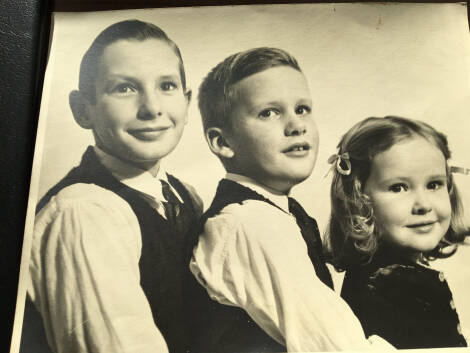
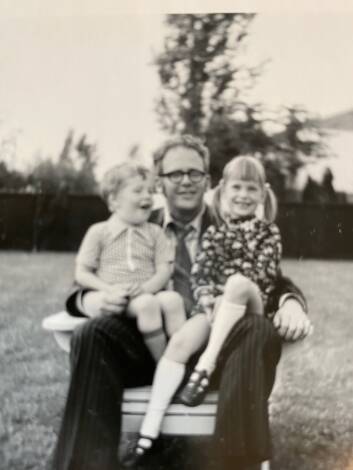
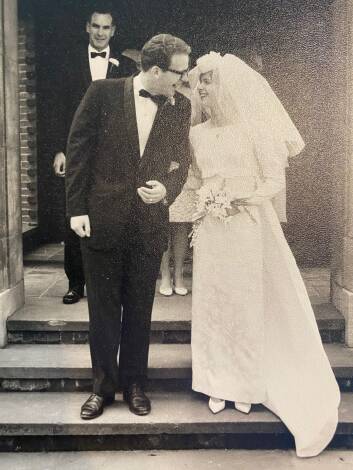
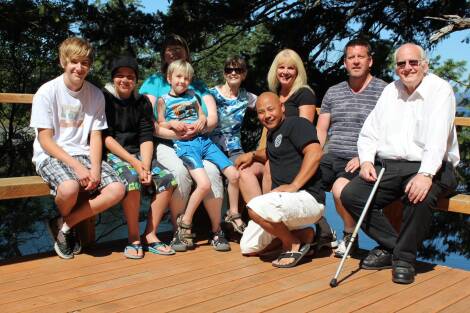
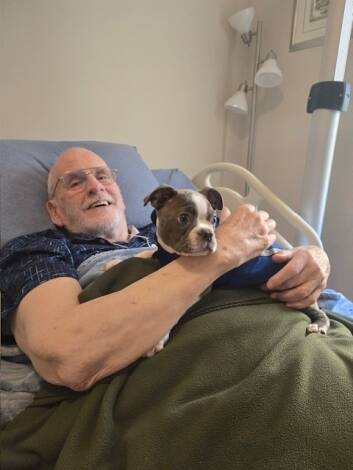
Memory wall
Before I’d even begun a career, as I was preparing to leave for university, I remember blathering on at one of our extended family luncheons about wanting to pursue comedy and acting — while anxiously acknowledging that such a path might not pay the bills. Ken brushed aside my practical worries with a wave of his hand and zeroed in on the ambition itself. “Listen,” he said, “you’re smart. You’ll always figure out how to make money — don’t waste time worrying about that. Do what makes you happy.”
At the time, that advice struck me as oddly paradoxical coming from Ken. As a child, I’d always found him a little intimidating — quick-tempered, impatient, often grouchy — though he was invariably kind and gentle with children, if not always (in my observation) with his own. His talk of happiness felt at odds with his demeanour, and for years I wondered whether he’d ever taken his own counsel. But with time, I came to see that he did, in his way, live by it. Ken may not have seemed conventionally happy, but he was profoundly engaged — doing what made him think, question, and wrestle with ideas. In his own deeply cogitative way, that was his form of happiness.
A dozen years later, I was working my way up at a Toronto ad agency and visiting Vancouver on business. Ken was City Manager at the time — a far weightier role than mine, but again he turned the spotlight away from himself. “I’m not doing anything interesting,” he said. “I want to hear what you’re up to.”
Fast-forward another fifteen years to a spirited chat about quantum computing and AI. Ken’s curiosity was as fierce as ever, his mind as quick, his questions sharper than mine. He kept referring to a “Watson machine” and pressing me to explain what I barely understood — and I realized, as usual, he probably knew more than I did.
Ken made a lasting impression on me, as he did on almost everyone he met — modest yet intimidating, gruff yet generous, endlessly inquisitive, and terrifyingly intelligent. I can only hope I remain as keenly engaged in “retirement” as he was.
It was with a heavy heart that I learned of Ken’s passing late this summer. Ken left an indelible mark on Canada - and especially in British Columbia.
With a distinguished career in public service, he was also a decorated student-athlete at UBC, he then went on to complete graduate studies in the United Kingdom before returning home to Vancouver, where he would later serve as Vancouver City Manager and then as the first ever CEO of the Greater Vancouver Transit Authority.
It was as City Manager that I first met Ken. I was a newly elected, idealistic park commissioner, and, to me, he was a giant, yet his door was always open.
I recall our early-morning breakfasts at a modest café near city hall, where his advice was clear, often blunt and always generous. As I left, he’d say with a smile, “Godspeed, young man.”
That work ethic and candor defined him. As deputy minister to premier Gordon Campbell, Ken oversaw 30,000 employees and drove major projects like the Pacific Gateway Trade Initiative.
When Ken was at the helm, things got done.
Even after retiring, he continued to help. I once asked him to advise us on a thorny port project. After hearing our CEO’s plan, Ken replied to my boss with a twinkle in his eye and a smile on his face, “Now why would you do a dumb thing like that?” That sparked a good-natured debate that led us to a solution. He left us again, with his trademark, “Godspeed, young man.”
Ken’s legacy is all around us : the E-Comm 9-1-1 centre, improvements in rapid transit, the Vancouver Convention Centre and planning for the 2010 Vancouver Olympics. He also championed reconciliation, establishing a scholarship to support students, working to build bridges between Indigenous and local governments.
The last time I saw Ken, he was in his retirement home, still following the news, still frustrated that “stuff wasn’t getting done.” As I left, he offered me his usual refrain.
Ken would have hated me giving this tribute. But I offer it not only for him, but as a reminder of the many public servants who give so much of themselves to make our communities, provinces and country better and stronger. Ken was a role model for them as he was for me.
So, colleagues, I ask you to join me in celebrating Ken Dobell: a life well lived and a legacy that will endure. Ken, may you finally take some time off.
Godspeed, my friend. Thank you.
Delivered by Senator Duncan Wilson to the Senate of Canada on October 8th, 2025
Work, because most of our conversations over the past few decades were about what I was up to, with whom I was working, what challenges I was encountering. When I asked Ken for advice he would always start by assuring me that he knew nothing at all, had no insight to offer -- and then he would without fail point to the crux of the issue. He rarely offered direct advice, but always asked tough questions and cheerfully poked holes in cherished assumptions until I looked at the problem in a new way. We never worked on anything together, but his influence shaped the work I do and how I do it.
He lives on in my day-to-day work in other ways, too. In his tenure as Deputy Minister to Premier Campbell, Ken played a central role in bringing BC to the table as a partner in the 2006 and 2007 Great Bear Rainforest Agreements – a now globally-recognized model of conservation, collaborative management, sustainable economic development, and innovative finance that continues to safeguard ecosystems and drive ever-expanding economic benefits across BC’s spectacular north Pacific coast. Ken helped protect the coast (and the salmon) that he loved, while making life better for thousands of households especially in Indigenous communities. I am grateful for his vision and proud to feel his influence while I carry forward some of that work.
Music, because no family gathering with Ken was without. The opening chords of the Messiah will forever evoke family Christmas gatherings, big tables in Vancouver restaurants, and the red plush seats of the Orpheum. At other times of year Ken sometimes passed along his extra tickets to Early Music performances at the Chan Centre, priceless gifts of otherworldly moments I still carry.
Work and music together, because my memories of Ken are infused with love, gratitude, and admiration, and have a Daniel Taylor soundtrack.
With love and deepest condolences to my cousins Leah, Colin, and Derek,
Darcy Dobell
Ken was such a huge part of my life from the early '80s to about 1999 at City Hall. Ken was always available to talk with anyone who stopped by his office, listening, challenging them to look at a situation from a different perspective, and just being the mentor he naturally was. It was an honour and an extreme pleasure to get to work for, and with, Ken. He was always so supportive of his staff.
I recall those years working in an environment with managers who worked hard with integrity, purpose, commitment: Ken, Fritz Bowers, Bill Curtis, Dave Rudberg, Peter Leckie, Don Forss, John Mulberry, Terry Bland, I could go on. It was a "work family".
Thank you Ken for EVERYTHING you did to help so many, and in so many ways ... public policy, public transit, education, etc.
You indeed have left big shoes to fill. Requiescat in pace dear Ken. You are gone physically, but your spirit will live on, never to be forgotten.
During my career at City Hall I reported to a triumvirate - Ken Dobell, Peter Leckie, and Terry Bland - all intellectual giants dedicated to the betterment of the City. Their contribution was immeasurable. The advice and support I received, particularly from Ken, made me a more effective employee and a better person.
More than that Ken was a great friend. Al and I lived not far from City Hall, on Ken’s route home to Tswassen. It became a Friday evening routine for Ken to drop by our house on his way home and wait out the traffic. The three of us would relax and share stories and laughs over a good bottle of red wine. Ken was always interested in how life was going for us. How are the kids? What’s new in labour law Al? What are you reading these days? Together we solved the problems of the world. Looking back now we treasure those memories.
In later years, as life took us in different directions, we didn’t see as much of Ken but he would call from time to time just to check in and see how we were doing. Recently, after not hearing from him in some time, he called, just days before his death. Al and I both got on the phone and once again we had a great conversation. We will miss him.
Patti Marfleet and Alan Hamilton
I wish I could properly thank him for his many acts of incredible generosity, like getting me a job when I first moved to Vancouver, or giving me a car when I first moved to Vancouver, or letting me store my furniture in the garage at the house in Tsawwassen when I left Vancouver, or taking the whole family to hear The Messiah at Christmases, or helping my family in a tough time…the list goes on. But years later when I’d mention these things, he would either shrug it off or look bemused as if he didn’t really remember doing it. As if I were handing him unearned credit.
Uncle Ken was intimidatingly intelligent, but his generosity, kindness, modesty, and humour is what I will always remember about him. He was a rare uncle - a rare human. I’ll never stop being grateful for his constant support and encouragement which shaped my life in profound ways. I shall miss him deeply.
My parents instilled in my brothers and I the importance of engaging in public service and leaving the world a better place. We accepted this responsibility, although I was much more laggardly than my brothers.
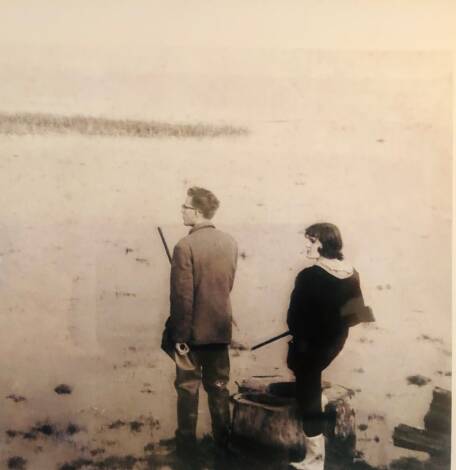
As a boy, Ken was good-natured and thoughtful, but given to daydreams and at school he had a tendency to gaze out the window, probably imagining himself somewhere off in a boat fishing. He enjoyed getting up at the crack of dawn to go out on the dyke with our father, holding a gun but preferring not to shoot the ducks. He was a sensitive boy and loved the outdoors. He claimed that it was his ambition to become a hermit. In time, he learned to pay attention in school and did very well, although I think his heart was often elsewhere.
Assuming leadership roles in public service comes at a great personal cost. Government systems and bureaucracies restrict how much leaders can do and limits how they are able to behave. Unions and the general public are ready to berate but reluctant to support people in leadership roles. It’s commonly said that you have to “have tough skin” to survive as leaders in such institutions.
I saw with Ken that he was very successful in his work and much admired by those who worked closely with him, but I also saw that there were challenging and hurtful situations that he learned to brush off. There were some vicious political attacks which he endured, noting that it went with the territory and “That’s politics.” Cose fan tutti. They all do it.
Through the years, Ken became more guarded. I found that the sensitive boy I knew for so many years was most often seen when he listened to music. When were at a Handel concert at the Chan Centre, for instance, I could feel him opening his heart and letting himself enjoy the music at a deep level. There were also many times when he witnessed pain and grief in others when you saw his compassionate response, as has been often noted in these comments. But mostly, I think, he had to protect himself with a cheerful smile and a tough skin.
I’m proud of the work my brother did and I know that many others are aware of his vast contributions to our city and province. But I’ve sometimes wished that he could have pursued his dream of becoming a hermit who played the guitar and fished and enjoyed a tranquil, contemplative life.
But it all worked out well for him. Ken’s family was his greatest joy. He enjoyed his colleagues and his work brought him deep satisfaction, achievement, fulfilment and respect. As it happened, he more than lived up to our parents’ expectations.
Like Rod, his older brother, Ken became a very hard act to follow.
I last sat down with him last summer in Victoria where his ever brilliant mind was somewhat frustrated by his physical limitations- but he never spoke of himself, always inquiring about projects and ideas and how to actually get things done, making supportive remarks ( to a 66 year old “student”!) and ever optimistic. He lived life well, leaves a long list of successful projects, and dozens of admirers.
Thank you Ken- you enriched so many lives, in a truly selfless way. We can only hope that fine people like you continue to seek public roles to enrich our world. You were truly a model for all of us.
Ken Dobell exemplified all the best of public service. He was smarter than everyone around him. The rumour was he took a course so he could talk to people in a way that would make him less intimidating, no small task given his larger-than-life physical size. He thought and acted on a different plane than most, but he never lorded his talent over those he worked with. He embodied integrity, imagination, and executive action. He led by example, and he gave freely of his time. When he sent out a 3:00 a.m. email, he knew most of us would be asleep, but he gave time from his day so everyone else would have some time in theirs. Vancouver will never have a combination in the City Manager’s Office like the Fritz Bowers, Ken Dobell tandem. Two humanist engineers who led by example, thought clearly, were guided by facts, and defined by action and accomplishment. Ken could not have been more generous with his time. He was always a teacher – generous, forgiving, and supportive. He was unencumbered by ego and driven by kindness. His discipline and dedication set the tone of executive action aiming at one thing - making things better for people, both at work and for the public. He sacrificed his time and himself for the good of the province. His influence spanned the country. He made Canada, British Columbia, and Vancouver better for all of us.
Like so many others I cannot find the words for the loss I feel. It is deep. My last visit to Ken, was recent. He seemed to be doing well. We carried on like we’d had no absences; arguing about what this or that meant, Ken piercing one of my wayward thoughts with “Come one Gord!’, laughing, talking about our most recent book recommendations, reminiscing.
They tell us to “Show, don’t tell”. Ken Dobell showed us all how we could be. He showed us what we could do. He smiled at our foibles and lifted us up when we were down. He was always there, and now he is not.
The gift of his life was to make us all better. We haven’t lost him if we remember his example. I loved him. I thank his family for sharing him. I am thankful he filled my life with so much. He was a giant in the life of our city, our province, and our country.
I imagine Ken now, sitting at a table in the corner of some room in the sky with Fritz and Art in conversation, a drink in hand. In the gaps of their conversation, Ken thinks about all those he touched and wishes us well.
I remember watching Ken on a plane once as we flew to Ottawa together to remind those in the nation’s capital that there was a place called British Columbia on the other side of the mountains. Ken hated flying but there we were on another trip. I looked across at one point ready to ask a question but, Ken was asleep. Looking restful. Relaxed. He was good at cat naps. He would bounce back after a couple of minutes and be ready to go. He’s not bouncing back now. The world is emptier, some of its kindness and gentleness has slipped from our grasps, but his example can fill the loss we feel. Ken would want us to fill that with what we learned from him. May he rest in peace and may we always hold his memory in our hearts.
I first met him during collective bargaining in 1984 when he was Vancouver’s Deputy City Manager and we have stayed in touch for the past 40+ years. Ken became the City Manager in 1990 succeeding Fritz Bowers, and we had many very interesting discussions both in terms of labour management, collective bargaining as well as emergency management.
Labour management matters were ones where his interest in the person almost always had him listening carefully to the human side of the issue at second stage of the grievance process. In one memorable case we had met in his office on a Friday afternoon and had put in our case regarding a pending dismissal when he said he would reserve his decision and think about it over the weekend. My response was that if he wanted to discuss it further, I would be available at any time and gave him my pager number.
At about 10 pm on Saturday he was at home and paged me to see if I wanted to chat further. I did and we spent the next 3+ hours until well past midnight faxing arguments and proposals back and forth until we had crafted a conditional return to work offer. That was Ken who was managing a very large organization, staying up past midnight working to solve a people issue.
Busy as he was, he always had time to talk, listen, debate and propose a resolution to challenging problems.
For more than 20 years, our friendship grew—especially after his retirement. We bantered about family, politics, and religion, and he always left me with something to think about. We would meet over sushi in Tsawwassen, B.C., where he lived after retiring, and later at Amica-On-The-Gorge Retirement Community in Victoria, B.C., when he needed more care. After I moved to Toronto, Ken called me monthly; we last spoke just 10 days before his passing.
This month the world lost a giant. And I lost a friend whose brilliant mind, kindness and wisdom left an indelible mark on my life.
His family was very important to him and I appreciated reading Colin's tribute below–and for the inclusion of the Dylan Thomas lyrics.
I'm sad to hear he has passed on but grateful to have had the chance to know such a wonderful man.
I met Ken in the early 70's. I had been hired by the City of Vancouver (on a one year contract) to design a "new" Water Street in Gastown; Ken was the newly promoted Sewers Engineer. How does a street designer meet a sewers engineer? Turns out that half of the old buildings on Water Street were hooked up to a sewer that no-one even knew existed: it was happily discharging sewage straight into Burrard Inlet; it was made of cedar. I am assuming Ken fixed it. I was too busy counting bricks. A lasting friendship popped up out of the rubble.
I had originally intended to stay at City Hall for (maybe) five years and then get a real life. I stayed for fifteen years. Ken was a major reason for that. He had a way of turning work into a series of fascinating adventures; so I stayed. When I left, I was an (acting) associate director of planning. Johnny Carline had decided that he wanted to do some actual planning, so he buggered off to some task force and lumbered me with his title and paper work. Kenneth thought that was hilarious.
Years later, when my daughter was born, Ken declared - for reasons known only to himself - that Stephani was his Long Lost God Daughter, and as such, could visit him at the City Manager's Offices at any time of her choosing. I had no firm understanding of what a god daughter even is, and absolutely no idea how you would go about losing one. So I did not argue with Kenneth. It was a lovely offer. One which Stephani accepted with some regularity over the first 3/4 years of her life. She adored Kenneth. Still does.
And so do I. Will I miss Ken Dobell? Absolutely not. As long as I have a life, Kenneth will be a compelling part of it. That's how he works.
Au revior, mon ami, au revior
More important than the work was the friendship. We debated and had differing views on a wide range of topics and thoroughly enjoyed every minute of those discussions.
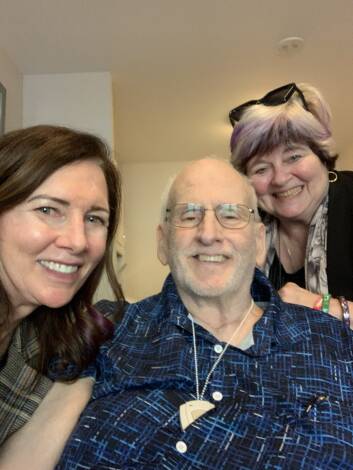
I miss him deeply. This photo is from our last visit.
Ken, Fritz, Peter, and Bill helped to mentor and guide me in my career with the City. I am forever grateful for their leadership and professionalism. With the passing of Ken, all these giants are now gone. Their legacy is the wisdom which has been passed on to so many past and present people engaged in public service.
Ken, I pass along my heartfelt thanks for all you have done.
A light has dimmed - passed on to future generations through his family, the Ken Dobell scholarship and our collective memories/actions. He took a strong interest in my SFU engineering student niece Leone and arranged, with his son Colin, a final year group project in robotics at Inuktun, foundational for her career. A great person - widely influential and deeply loved.
When I discovered Ken was in the Amica facility on the Gorge, I took to visiting him every Thursday at 2pm. We would talk each Thursday for three hours, mainly about what was most important to both of us - family. And we would reminisce a bit about the people we had worked with together. Ken's memories about what he had worked on and the people with whom he had worked, were almost universally positive. He had reached a very good place.
Now he has gone and there is a big hole in my week. But he left me with one treasure. He regarded me as a friend, and I his, and there is little that could me make more proud. He was a good man.
Our one-on-one chats were always enjoyable. We’d talk about the books we were reading, current events, and he’d always ask about work with genuine interest. Ken was one of the most educated and generous men I’ve ever known. His intellect was matched only by his warmth.
He never sugar-coated the truth—he spoke his mind, even when we didn’t see eye to eye. But that was part of what made Ken, Ken and why I enjoyed our chats. We’d agree to disagree, share a laugh, and declare that together, we could take on the world.
His passion for music and fishing never waned. Even in his later years, when he could no longer cast a line or attend a concert himself, he found joy in hearing about others’ adventures—living vicariously through the stories we shared. Whether it was a fishing trip, a theater outing, or others travel, he listened with delight.
When I was ill, Ken called often—sometimes twice a day—just to check in. That’s who he was: thoughtful, loyal, and deeply caring.
He had a soft spot for Eccles cakes, and I loved baking them for him. It was a small gesture, but one that brought us both joy.
Some of my favorite memories fishing are at HiHium Lake with my cousin Floyd, my dad and grandad. I remember the 6-hour drive from the ferry terminal just get into a van to drive on a bumpy road where Floyd would almost throw up on me. One time I had a big fish (my Dad says it was “huge!”) on the line as were heading back into the cabin. Unfortunately, I lost it, but I still remember that fish every time I go fishing. Even though my cousin Floyd would often catch the biggest fish, I would brag that I caught a rock once at HiHium and he didn’t.
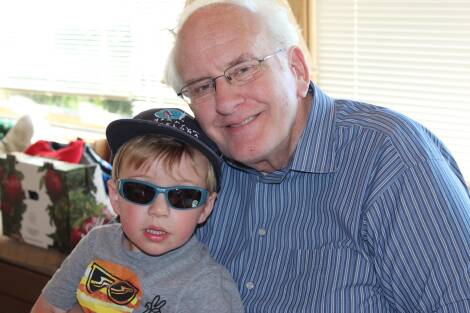
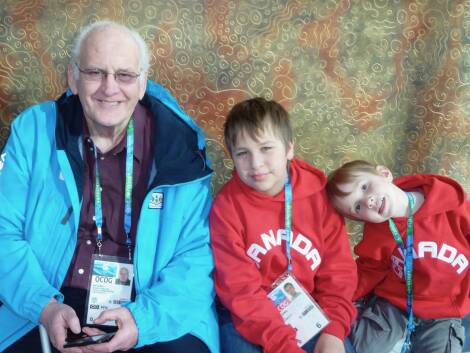
Looking back, the opportunity of going to the 2010 Olympic games was an experience that changed my life. It was a rare and memorable experience on its own, but the games also helped me discover my love and passion for sports. The 2010 Olympics are a part of the reason I got my degree in sports management. My grandfather was always supportive and encouraging of my life goals
One of my earliest clear memories was him taking me to my first NHL game: The California Golden Seals against the Vancouver Canucks. We sat in the very last row at the top of the stadium, and the Canucks played poorly; with less than 3 minutes to go, they were down 4-1 so Dad decided we should leave and beat the parking lot traffic. I protested, but we left anyway … we got to the car and turned on the radio and the score was now tied, with the game headed to overtime. We joked several times over the years that I never forgave him for that.
Around that same time, and for several years, Dad was an avid photographer. I remember a few weekends where he would take me around Ladner and Steveston marinas and shorelines in search of subject for his pictures. He took shots of boats, birds, fishing nets, and interesting trees – all of which he developed in a dark room he setup up in the house. Although he never seemed satisfied with his pictures, he did frame a few and hang them in our living room.
As a kid, and even into adulthood, the thing that most amazed me about him was his knowledge; he seemed to know something about almost everything. Once, at age 17, my friend Bob and I were wandering around Chinatown – mostly just out of boredom. Bob purchased a strange little sword at one of the stores, explaining to me that it was a “Kukri” or Gurkha sword and it was bent halfway up the blade to give it mechanical advantage while slashing (Bob knew about these things). I thought it was kinda cool and asked Bob what the strange figure-8 notch at the base was for; he didn’t know. We spent most of the next week in the school library and talking to our history teachers, trying to figure out its purpose. Dad had recently bought some encyclopedias on CD-Rom (this was well before AI, or smartphones, or even the internet), so we decided to search through them for an explanation. We found lots of pictures of the sword, and a plethora of information on the Gurkhas, but not the answer we were looking for. Dad stuck his head in the door and told us he was going to need the computer to do some work and asked what we were doing. I told him the story. This is the conversation that followed:
Dad: “Is it a real Gurkha sword?”
Bob and Colin: “We think so”
Dad: “With the bent blade?”
Bob and Colin, looking at each other: “Yes”
Dad: “And the little notch above the handle, to keep the blood from dripping on your hand?”
Bob and I were both agape; but we shouldn’t have been surprised. That was just Dad.
Up until his very last days, he was a voracious reader. When I was young, it was common for him to be at the dinner table reading a Nature, Scientific American, or Astronomy magazine. And he devoured novels faster than anyone. It was always a challenge to find an author he didn’t know or book he hadn’t read.
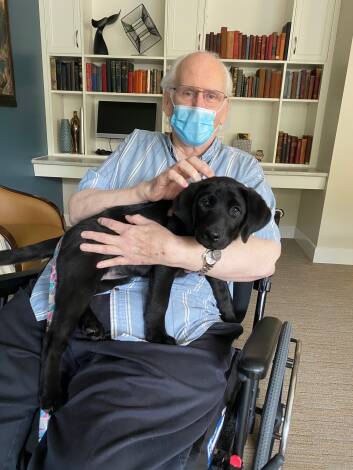
He loved good food (just don’t ever try to pay for lunch!), good dogs, and almost any kind of debate. Most of all, he really loved it when his family (particularly grandkids) came to visit, and he was especially fond of the regular visits and calls he got to have with former colleagues.
Later in life he was adamant that, when he died, there should be no service. But on multiple occasions when I was a teenager, he told me to play the audio of Dylan Thomas reading “And Death Shall Have No Dominion” at his funeral. Link and text are provided below.
https://youtu.be/eB7QgPb6FYw?si=pHdQl5BPBrL-BuVY
And death shall have no dominion.
Dead men naked they shall be one
With the man in the wind and the west moon;
When their bones are picked clean and the clean bones gone,
They shall have stars at elbow and foot;
Though they go mad they shall be sane,
Though they sink through the sea they shall rise again;
Though lovers be lost love shall not;
And death shall have no dominion.
And death shall have no dominion.
Under the windings of the sea
They lying long shall not die windily;
Twisting on racks when sinews give way,
Strapped to a wheel, yet they shall not break;
Faith in their hands shall snap in two,
And the unicorn evils run them through;
Split all ends up they shan't crack;
And death shall have no dominion.
And death shall have no dominion.
No more may gulls cry at their ears
Or waves break loud on the seashores;
Where blew a flower may a flower no more
Lift its head to the blows of the rain;
Though they be mad and dead as nails,
Heads of the characters hammer through daisies;
Break in the sun till the sun breaks down,
And death shall have no dominion.
Donate


 Français
 Deutsch
 Nederlands
 Español
 Português
 Magyar
 Русский
 繁體中文
繁體中文