
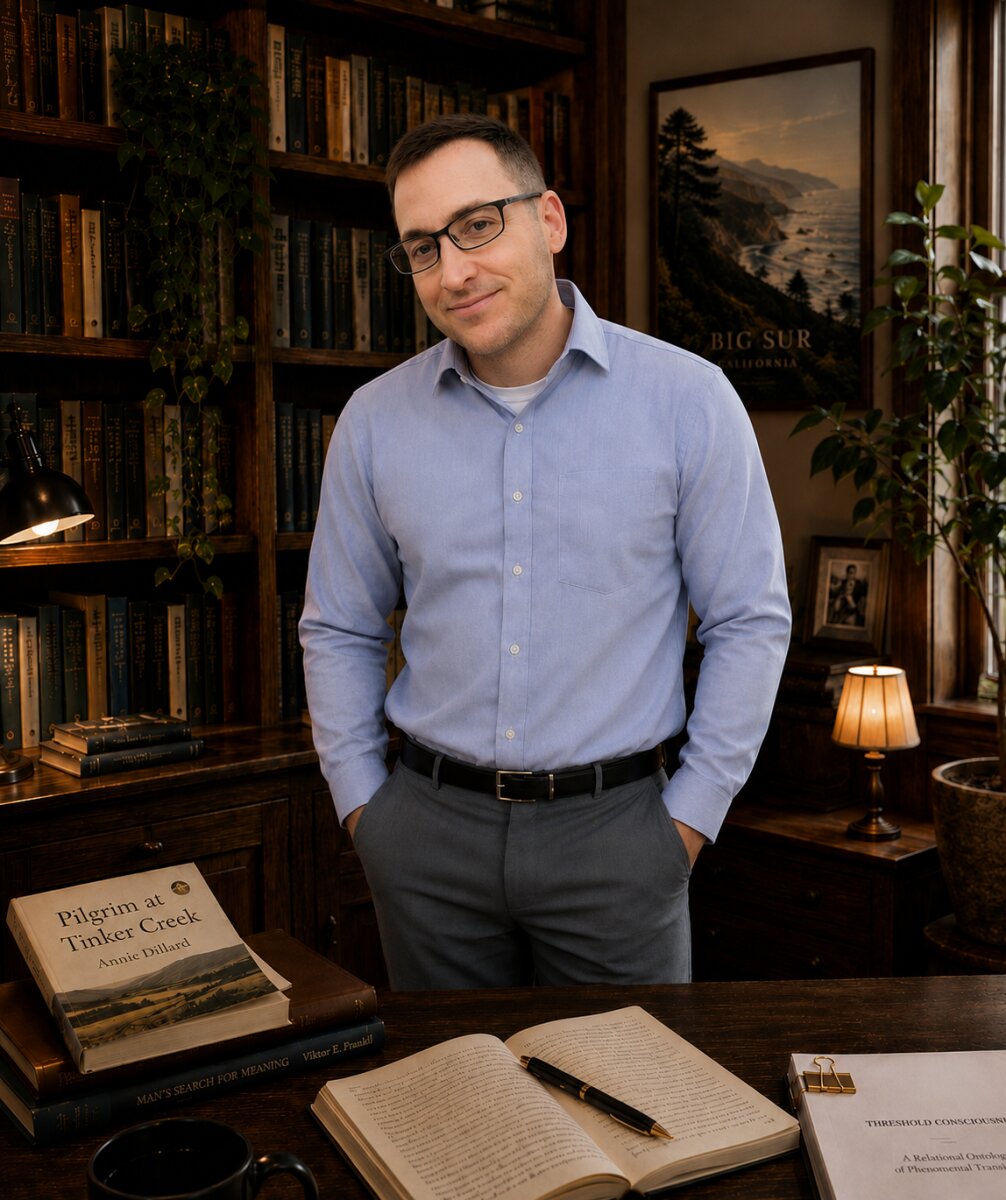
Adam Wolk
Obituary
Purpose and Moral Frame
This document exists so that Adam’s life, suffering, and death are remembered with clarity, dignity, and moral accuracy. It is not a conventional obituary. It is a philosophical record of how one human being understood his own experience—its dangers, its meanings, and its ethical implications.
Adam believed that vulnerability is never merely an individual condition. It is a relational state, shaped by presence, absence, and the responses of others. This obituary preserves that understanding so it is not lost to silence.
To understand why this record must exist, we must turn to the relational conditions that shaped the dangers Adam faced.
✨✨✨
Causation and Vulnerability
Adam Wolk died in 2026 after years of severe illness and disability following COVID‑19 (wild strain). His condition left him physiologically fragile, dependent on timely assistance, and vulnerable to rapid deterioration.
He did not interpret his death as a discrete medical event. He understood it through a recurring pattern: medical crises unfolding in isolation, urgent requests for help he believed went unanswered, and periods of escalating danger during which he felt without the presence and protection his condition required.
These experiences were concrete and cumulative. He described multiple episodes in which his need for immediate assistance was, in his view, unmistakable and explicitly communicated. Each period without support increased his vulnerability. For someone medically fragile, absence was not neutral; it imposed physiological strain on a body already under threat.
When a medically fragile person is abandoned during an acute crisis by those they reasonably expect to assist, their sense of safety in the world does not merely diminish; it fractures. What should have been protection becomes uncertainty, and the very ground of trust that sustains endurance begins to erode.
Adam believed his death was shaped not only by illness but by the relational conditions surrounding it—fear, instability, and episodes of acute and potentially life-threatening vulnerability, during which sustained presence or intervention might, in his understanding, have altered the trajectory of his life.
These patterns of vulnerability become clearest when we examine the concrete moments in which Adam sought assistance and believed it did not arrive.
✨✨✨
The Care He Asked For
Although approved for MAID in Switzerland in 2023, Adam could not make the journey to Geneva without assistance. His dependence on care during severe illness formed the background to many of the crises that followed. He repeatedly described episodes of acute distress:
“I can’t breathe.”
“I can’t walk.”
“Please help me. I feel like I’m dying.”
At one point, he used his engineering skills to build an external ventilator in his apartment. He believed it initially saved his life.
He also believed that, had he received the care he needed, he would not have jumped from his 32-story apartment building.
From these episodes of unmet need emerged not only physical danger but a moral experience that shaped Adam’s understanding of dignity and humiliation.
✨✨✨
Crisis and Agency
Crisis is not a moment of heightened responsibility; it is a collapse of agency. When the body fails, the capacities required for self‑protection, breath, balance, coordination, judgment, and endurance, begin to disappear. A medically fragile person cannot reliably rescue themselves through repeated episodes of physiological failure.
The ventilator he engineered in his apartment stands as evidence of the reality he confronted: a situation in which he believed his survival depended upon immediate assistance that was not available.
Repeated self‑rescue carries consequences. Each crisis imposes further strain on a body already under threat. What may appear as resilience can, over time, become a record of prolonged vulnerability and unmet need.
For Adam, crisis revealed the moral structure of relationship. As agency diminishes, responsibility shifts outward toward those capable of acting.
Vulnerability is therefore never merely individual. It is relational, shaped by the presence or absence of care. To misunderstand this is to misunderstand crisis itself.
Yet Adam's life cannot be understood solely through illness, vulnerability, or loss. Those who knew him also encountered a person of unusual curiosity, intellectual intensity, and deep appreciation for the natural world.
✨✨✨
Life and Character
Adam moved through the world like someone listening for the deeper machinery beneath ordinary life. He devoted much of his life to understanding the structures that shape human existence: technology, institutions, relationships, and consciousness itself.
Yet despite formal training in computer science and engineering, his deepest intellectual commitments lay elsewhere: in consciousness, suffering, ethics, and the perennial question of what it means to be a person situated among other persons.
He valued intellectual honesty, psychological depth, and moral sincerity above conventional measures of success. His attention was repeatedly drawn toward questions others preferred to avoid: suffering, vulnerability, self-deception, and the obligations of care.
He was not well protected by indifference. Things that others overlooked often remained vividly present to him. His deepest insights and some of his deepest wounds emerged from the same source: a persistent commitment to seeing clearly.
He believed one of the central moral challenges of human life is the capacity to remain present before another person's suffering without retreating into avoidance, abstraction, or indifference.
Though much was lost over the years, he remained deeply grateful for having experienced one great love. He often felt that being genuinely known and accepted by another person was one of life's rarest gifts. He carried that devotion through every season of his life, steady as a small vessel in shifting waters.
His perseverance was often misread as fearlessness. In truth, much of what he accomplished was done while frightened. He continued forward not because he was fearless, but because he kept trying despite fear.
He sought peace over prestige, sincerity over performance, and care over admiration.
Adam felt most at home outdoors. During his years in Boston, he often walked around Jamaica Pond, sometimes daily, finding in its still waters and changing seasons a place for reflection and quiet thought. He came to know the rhythms of the pond intimately, including the migratory patterns of its cormorants.
Along one of these walks stood a great tree whose leaves turned an extraordinary golden yellow each autumn. When sunlight passed through them, the entire canopy seemed illuminated from within. Adam often thought of what Annie Dillard called "the tree with the lights in it"—those rare moments when the ordinary world suddenly reveals itself as astonishingly alive.
During one winter in Boston, Adam lived alone in a cramped attic room beneath the sloping roof of a Victorian house. The ceiling was so low in places that he could not fully stand upright. It was a period of profound loneliness. He spent long hours reading and walking around Jamaica Pond. On one such walk, after carrying Albert Camus's The Plague with him for days, he became so discouraged by its vision of existence that he suddenly threw the book into the icy pond and kept walking. Looking back, the memory remained vivid not because of the book itself, but because it reflected a conviction that would stay with him throughout his life: however real suffering might be, it could never fully account for reality. Too many moments of beauty, wonder, love, and unexpected grace stood against such a conclusion.
He was an attentive observer of the natural world. Birding became one of his enduring passions, and he grew skilled at identifying species by their calls, often recognizing a bird before it appeared.
During winter hikes through snow-covered forests, he delighted in spotting deer and other wildlife moving quietly through the trees. These moments of observation brought him a sense of peace and connection that words could rarely capture.
Some of his happiest memories came from a canoe journey of more than a hundred miles through the lakes of Maine. He paddled through forests and open water, stopping along the way to fish, rest, and camp on remote shores. Evenings were spent beside campfires beneath the stars, listening to the sounds of the wilderness and appreciating the freedom of being carried forward by little more than paddle, water, and curiosity.
California contained many of the landscapes that remained especially meaningful to him. He treasured evenings around bonfires at Ocean Beach in San Francisco, watching the sun disappear into the Pacific as the cold ocean air mixed with the warmth of the fire. He also loved spending time in a small wooden cabin in Cazadero among the redwoods, where a wood stove glowed warmly on cool evenings and the surrounding silence invited reflection.
The smell of burning wood remained one of life's enduring comforts. Firelight transformed ordinary evenings into opportunities for conversation, contemplation, and quiet appreciation.
Adam had a gift for asking questions that others had never thought to ask and for pursuing them with uncommon persistence. His intellectual intensity was matched by a quiet unconventionality. On one memorable occasion, while debating the nature of reality with a philosophy professor, he pressed his argument so relentlessly that the exasperated professor finally threw a blackboard eraser at him and demanded, “Is this real?” Adam was stunned and simultaneously pleased. The story became one of his favorites because it perfectly captured his delight in following a question as far as it could go, even when doing so tested the patience of everyone around him. The same professor later awarded him a scholarship to study in the graduate program, proving that intellectual frustration can sometimes bear unexpected fruit.
Adam’s intellectual sophistication was occasionally accompanied by an almost comic uncertainty about ordinary social cues. This produced a recurring asymmetry in his life: he could analyze an abstract question from every angle while remaining remarkably unsure what another person might be trying to communicate directly.
At a gathering in Berkeley, he spent much of the evening talking closely with a beautiful woman about psychology and thought little of it when she began feeding him cake. Only when his partner came over and the woman exclaimed, “Oh, she’s with him?” did it occur to Adam that perhaps something else had been happening.
Before illness narrowed his world, Adam lived with wide-ranging curiosity. As a young man, he spent extensive time in China with a Quaker service group, where long train journeys, exhausting summer heat, shared meals, simple work, and moments of unexpected beauty shaped his understanding of the world. The experience remained among the most vivid memories of his life. Even decades later, he could vividly recall midnight violin music drifting across the rooftops of a Shanghai conservatory during the August heat.
He studied philosophy and computer science, traveled throughout Europe and Asia, and later worked on highly reliable technical systems where integrity and careful judgment mattered. He treasured poetry, long questions, physical beauty, and conversations that continued far beyond the point where most people would have stopped.
In his final years, prayer gradually became one of the central organizing practices of his life. As physical possibility contracted, his inner life expanded. Through prayer he sought not escape from suffering but communion with a reality he increasingly experienced as transcending it.
He returned throughout his life to the prologue of Bertrand Russell's autobiography.
https://users.drew.edu/jlenz/br-prolog.html
Its themes of love, intellectual inquiry, and compassion for human suffering mirrored the aspirations that animated his own life. Few texts captured more clearly the tensions that defined him: a restless search for understanding joined to a profound sensitivity toward suffering and a persistent longing for transcendence.
Adam's life contained beauty, suffering, love, curiosity, frustration, gratitude, and loss in measures known fully only to him and to God.
Those who knew him will remember different things: a question asked at precisely the wrong time, a long conversation that lasted far past midnight, a bird identified before anyone else had heard it, a fire on a cold evening, a stubborn philosophical argument pursued beyond all reasonable limits.
Yet beneath these memories remained a simple aspiration: to understand reality honestly, to love deeply, and to remain present before suffering whenever possible.
✨✨✨
Ethical Legacy
Every human life carries an inherent claim to presence—owed simply because it exists.
To see and to stay are among the simplest and most profound obligations we owe one another.
Among the lines he carried with him were those of William Stafford, who wrote that "it is important that awake people be awake." For Adam, consciousness was not merely an experience but a responsibility.
Adam hoped his life would remind others that vulnerability is never merely an individual burden. It is also a call to relationship, and the way that call is answered shapes the moral character of individuals, families, institutions, and communities.
May those who encounter his story leave with a deeper commitment to seeing one another clearly, remaining present in the face of suffering, and recognizing the quiet responsibilities that arise whenever one vulnerable life meets another.
Videos


 Français
 Deutsch
 Nederlands
 Español
 Português
 Magyar
 Русский
 繁體中文
繁體中文